
Every American sports fan knows that betting offers the thrill of high stakes and big wins, but only a fraction actually see long-term success. Over 85 percent of casual American bettors lose more than they win each year, highlighting the importance of a smart, disciplined approach. Understanding how to set realistic goals, track your budget, and make data-driven decisions will set you apart from the crowd and give your bets a real edge.
Table of Contents
- Step 1: Assess Personal Betting Goals And Budget
- Step 2: Research Teams, Players, And Betting Markets
- Step 3: Analyze Statistical Data And Recent Trends
- Step 4: Compare Odds Across Trusted Sportsbooks
- Step 5: Track Performance And Refine Strategies
Quick Summary
| Key Point | Explanation |
|---|---|
| 1. Set a Monthly Betting Budget | Establish a clear budget for gambling that reflects discretionary income to avoid financial strain and emotional betting. |
| 2. Conduct Thorough Research | Go beyond basic statistics by analyzing teams, players, and market trends to make informed betting decisions. |
| 3. Utilize Statistical Data | Interpret comprehensive data and avoid biases to identify consistent patterns and underlying trends in sports performances. |
| 4. Compare Odds Across Platforms | Log and compare odds from different sportsbooks to maximize returns and make calculated betting decisions. |
| 5. Track Performance Regularly | Create a system to track your betting history and adjust strategies based on performance analysis and market changes. |
Step 1: Assess personal betting goals and budget
Successful sports betting starts with honest self reflection and strategic financial planning. Your betting approach should align closely with your personal financial situation and entertainment objectives, transforming gambling from a random activity into a calculated pursuit.
Begin by establishing a clear monthly gambling budget that represents discretionary income you can comfortably lose without impacting essential expenses. Financial experts recommend staking between 1% and 5% of your total monthly budget per individual wager to effectively manage risk. This disciplined approach prevents emotional betting and protects your overall financial health.
To create a sustainable betting strategy, treat gambling as an entertainment expense rather than an income source. Set strict limits on both time and money spent and commit to those boundaries. Consider withdrawing a predetermined cash amount for betting sessions to prevent overspending through digital transactions. Remember: smart betting is about consistent management, not chasing massive wins.
As you move forward, remain flexible and willing to adjust your goals based on actual performance and changing personal circumstances. Your betting budget is a living strategy that should evolve with your experience and financial landscape.
Step 2: Research teams, players, and betting markets
Successful sports betting hinges on comprehensive research that goes beyond surface level statistics. Your goal is to develop a nuanced understanding of the teams, players, and broader market dynamics that influence betting outcomes.
Start by diving deep into team and player performance metrics. Analyze historical match data and recent performance trends to identify patterns that can inform your betting strategy. Pay special attention to factors like player injuries, team morale, recent wins and losses, and head to head records. Interestingly, research suggests that bettors often exhibit home bias, unconsciously favoring their home teams, which can skew objective analysis.

Beyond individual team statistics, understand the broader betting market landscape. Study emerging betting trends and market movements that might indicate insider knowledge or significant shifts in team performance. Look for discrepancies between public perception and actual team capabilities, as these can reveal valuable betting opportunities. Remember that successful betting is about making informed decisions based on comprehensive research, not emotional attachments or gut feelings.
As you accumulate research, develop a systematic approach to organizing and evaluating information. Your research process should be methodical, objective, and continuously evolving as you gain more insights into sports betting dynamics.
Step 3: Analyze statistical data and recent trends
Mastering sports betting requires more than casual observation. Your ability to interpret statistical data and understand recent performance trends will separate smart betting from pure guesswork.
Cognitive biases can significantly distort your statistical analysis, making it crucial to approach data with a disciplined and objective mindset. Bettors frequently fall prey to recency bias, overemphasizing recent performance while overlooking long term patterns. Develop a systematic approach by creating comprehensive spreadsheets that track team and player statistics across multiple seasons, not just the most recent matches.
Understand why tracking betting stats matters by focusing on key performance indicators like win percentages, scoring averages, defensive metrics, and historical head to head results. Look beyond surface level numbers to identify nuanced trends that most casual bettors miss. Pay special attention to contextual factors such as player injuries, team chemistry, and competitive dynamics that raw statistics might not immediately reveal.
Remember that successful statistical analysis is an ongoing process. Continuously update your research, remain adaptable, and be willing to challenge your own assumptions. The most profitable bettors are those who can objectively interpret data without emotional attachment to their initial hypotheses.
Step 4: Compare odds across trusted sportsbooks
Successful sports betting requires strategic comparison of betting opportunities across multiple platforms. Your goal is to maximize potential returns by identifying the most favorable odds available in the market.
Responsible gambling tools can help you track and compare betting options systematically, ensuring you make informed decisions. Create a spreadsheet or use specialized tracking apps to log odds from different sportsbooks, comparing lines for the same event across multiple platforms. Pay close attention to subtle variations in point spreads, moneylines, and total scores that could impact your potential payout.
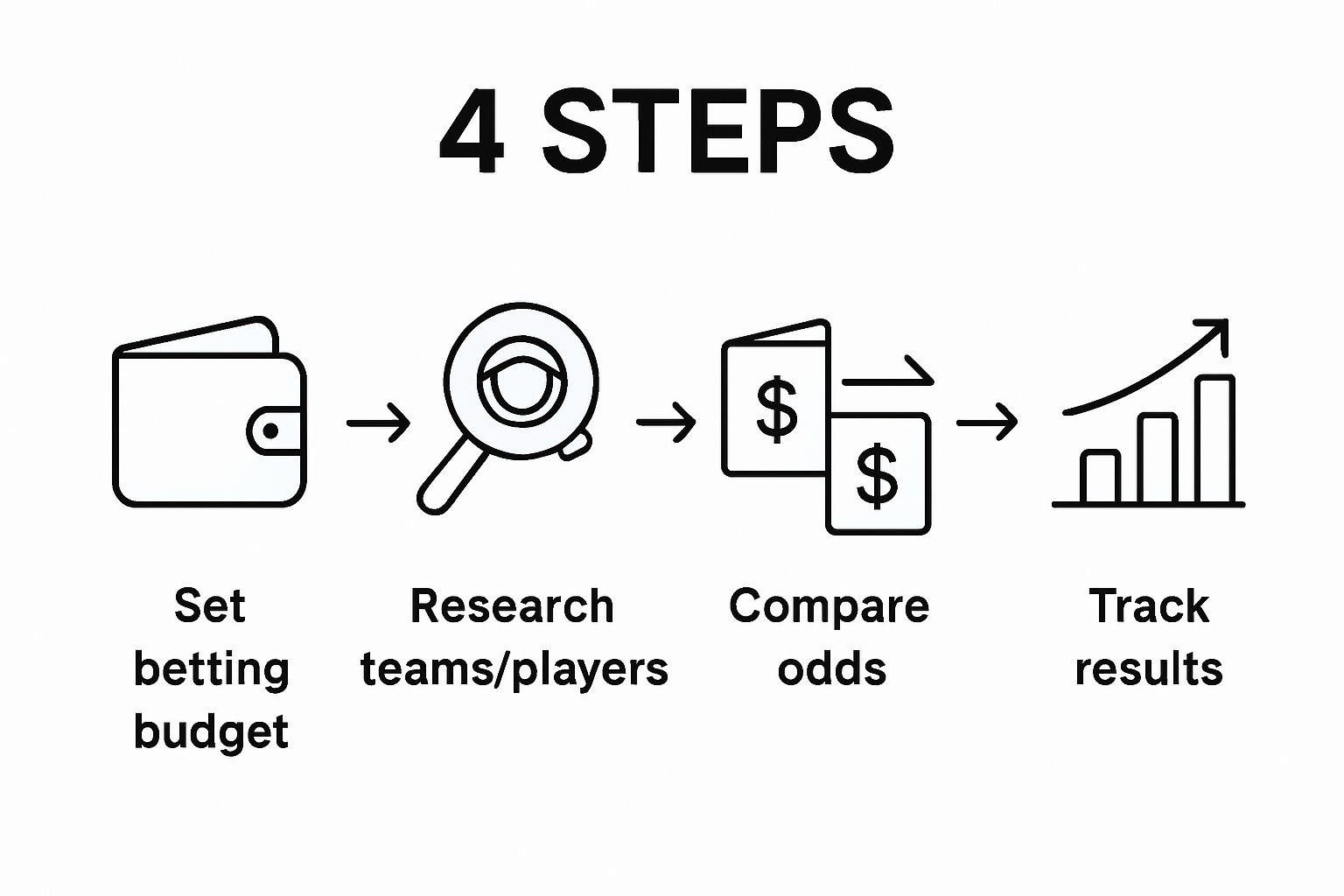
Interpret odds and probabilities carefully to understand the true value of each betting opportunity. Look beyond the surface numbers and consider factors like implied probability, historical performance, and potential risk. Some sportsbooks offer more favorable lines for specific types of bets or particular sporting events, so diversifying your sources can provide a significant strategic advantage.
Remember that comparing odds is not just about finding the highest potential payout. It is about understanding the nuanced differences between sportsbooks and making calculated decisions that balance potential returns with realistic risk assessment.
Step 5: Track performance and refine strategies
Sports betting success demands continuous self evaluation and strategic adaptation. Your ability to analyze past performance and adjust your approach will determine long term profitability and sustainable betting practices.
Responsible gambling tools provide critical insights into your betting performance, helping you maintain an objective perspective on your wagering habits. Create a comprehensive tracking system that logs every bet including stake amount, odds, event details, and outcome. Use profit and loss statements to identify patterns in your betting behavior such as which sports or bet types consistently yield better results.
Use advanced betting analytics to understand your performance trends and develop a data driven approach to strategy refinement. Calculate key metrics like return on investment, win rate, and average stake to gain deeper insights into your betting effectiveness. Be prepared to ruthlessly eliminate strategies that consistently underperform and double down on approaches that demonstrate consistent profitability.
Remember that strategy refinement is an ongoing process. Your betting approach should be fluid and adaptable, always learning from past experiences and adjusting to changing market conditions. Treat each bet as a learning opportunity and maintain a disciplined, analytical mindset.
Elevate Your Betting Strategy with Betco AG
Picking winning sports bets consistently means overcoming challenges like managing your budget, analyzing statistics accurately, and comparing odds wisely. This article highlights essential steps such as disciplined budgeting, in-depth research, and strategic odds comparison to help you avoid common pitfalls like emotional bias and poor data interpretation. If you want to put these concepts into action and improve your betting game, exploring expert insights and practical strategies is key.

Discover comprehensive support for your betting journey at Sports Betting Tips, Strategies & Insights | Category Betco. Betco AG offers a secure, user-friendly platform where you can access live betting markets, track your bets, and apply responsible gambling tools to maintain control and discipline. Don’t wait to turn your knowledge into real results. Visit Betco AG now to start betting smarter and take advantage of expert resources on Sports Betting Guides and Resources | Betco while benefiting from the safest practices outlined in Responsible Gambling and Security | Betco. Your winning streak begins when preparation meets opportunity.
Frequently Asked Questions
How can I assess my personal betting goals and budget?
Successful sports betting starts with evaluating your financial situation and entertainment objectives. Establish a monthly gambling budget that allows for discretionary spending, ideally allocating between 1% and 5% of this budget for each wager. Review your budget regularly to ensure it aligns with your evolving goals.
What research should I do on teams and players before placing a bet?
To make informed betting decisions, analyze detailed performance metrics for teams and players. Investigate historical data, recent trends, injuries, and team dynamics that could affect the game outcome. Create a checklist to evaluate these factors systematically before placing your bets.
How can I interpret statistical data when betting on sports?
Master statistical analysis by focusing on key indicators such as win percentages and scoring trends. Track statistics over multiple seasons rather than only recent performance to avoid biases. Use organized spreadsheets to keep a clear view of relevant data for each team and player.
Why is comparing odds across sportsbooks important for successful betting?
Comparing odds helps you find the best possible returns on your bets. Analyze various platforms and log their odds for the same events, paying attention to subtle differences. By consistently comparing odds, you can ensure you maximize your potential payouts for each wager placed.
How should I track my betting performance and adjust my strategies?
To refine your betting strategies, maintain detailed records of all your bets, including stake amount, odds, and outcomes. Use this data to evaluate your success rate over time and identify patterns in your betting behavior. Review your performance regularly, at least once a month, to adapt your strategies based on what works best for you.