
Most American bettors are surprised to learn that the average sportsbook margin quietly claims between 4 percent and 10 percent of every wager. This hidden commission is built into the odds, shaping your potential winnings in subtle but real ways. Knowing how bookmakers set these margins can make the difference between casual losses and smarter bets. Discover the real impact of betting margins and common mistakes even seasoned American sports fans make.
Table of Contents
- Defining Betting Margin And Common Misconceptions
- How Betting Margin Is Calculated In Sportsbooks
- Types Of Betting Margins And Their Impact On Odds
- Real-World Examples: Margin Effects On Bets
- Minimizing Losses And Maximizing Value As A Bettor
Key Takeaways
| Point | Details |
|---|---|
| Understanding Betting Margins | Betting margins, or vigorish, are essential for bookmakers to ensure profitability and are factored into betting odds. |
| Calculating Margins | Professional bettors calculate implied probabilities from odds to understand the actual costs embedded in their wagers. |
| Types of Margins | Different margin strategies like fixed, dynamic, and competitive affect betting opportunities and potential returns. |
| Strategic Betting Approaches | Bettors should compare odds across sportsbooks and recognize market inefficiencies to maximize value and minimize losses. |
Defining Betting Margin and Common Misconceptions
Betting margin, often referred to as the vigorish or juice, represents the subtle financial mechanism that ensures bookmakers maintain profitability across sports wagering platforms. This built-in commission quietly influences betting odds and directly impacts potential winnings for bettors.
At its core, the betting margin functions as a risk management strategy implemented by bookmakers. When you place a bet, the underlying odds are subtly adjusted to guarantee the house maintains a consistent profit margin, regardless of the sporting event’s final outcome. Typically represented as a percentage, this margin is embedded within the betting lines, creating a slight mathematical advantage for the bookmaker.
Common misconceptions about betting margins often revolve around their complexity and perceived unfairness. Many bettors mistakenly believe that betting margins represent pure profit for bookmakers, when in reality, they represent a sophisticated risk mitigation strategy. The margin ensures operational sustainability by compensating for potential losses and covering administrative costs associated with maintaining betting platforms.
- Betting margins are not arbitrary percentages
- The margin varies across different sports and events
- Professional bettors understand and calculate margins to identify value bets
- Margins typically range between 4% to 10% depending on the specific market
Understanding betting margins empowers bettors to make more informed wagering decisions. By recognizing how these margins are calculated and integrated into betting odds, players can develop more strategic approaches to sports betting and manage their expectations regarding potential returns.
How Betting Margin Is Calculated in Sportsbooks
Bookmakers employ sophisticated mathematical formulas to calculate precise betting margins that guarantee their financial sustainability. The core calculation involves converting betting odds into implied probabilities, which reveals the hidden percentage that ensures the sportsbook maintains a consistent profit regardless of the event’s outcome.

The standard method for calculating betting margins involves a multi-step process that transforms decimal odds into implied probabilities. Professional bettors understand that this calculation reveals the true cost embedded in each wager. For instance, when examining odds of 1.91, the implied probability calculation works as follows: (1 / 1.91) x 100 = 52.36%. By adding the probabilities for both potential outcomes and subtracting 100%, bettors can determine the exact margin built into the betting line.
Key factors influencing betting margin calculations include the specific sport, type of bet, and market competition. Different sports and betting markets feature varying margin percentages, typically ranging between 4% to 10%. Implied probability represents the most critical metric in this process, allowing bettors to understand the true mathematical landscape of their potential wagers.
- Margin percentages vary by sport and betting market
- Decimal odds provide the most straightforward calculation method
- Professional bettors use margin calculations to identify value bets
- Lower margins indicate more favorable betting conditions
Understanding these calculations empowers bettors to make more strategic decisions. By recognizing how sportsbooks build their mathematical advantage, players can identify betting opportunities with more favorable odds and potentially improve their long-term wagering success.
Types of Betting Margins and Their Impact on Odds
Sportsbooks employ diverse margin strategies that fundamentally shape betting opportunities and potential returns. Low-margin betting models represent a sophisticated approach where bookmakers intentionally reduce their profit percentage to attract more sophisticated bettors, creating more competitive and attractive wagering environments.
The primary types of betting margins include fixed margins, dynamic margins, and competitive margins. Fixed margins maintain a consistent percentage across different sports and events, typically ranging between 4% to 6%. Dynamic margins fluctuate based on market conditions, event popularity, and perceived risk, allowing bookmakers to adjust their mathematical advantage in real-time. Competitive margins emerge in highly saturated markets, where multiple sportsbooks vie for bettor attention by minimizing their built-in mathematical edge.
Professional bettors pay close attention to margin variations as they directly impact potential winnings. Smaller margins translate to more favorable odds, giving players a slightly improved chance of generating positive returns. Different sports and betting markets exhibit unique margin characteristics: football might feature tighter margins compared to more niche sporting events where bookmakers require additional risk compensation.
- Fixed margins provide consistent betting environments
- Dynamic margins adapt to market conditions
- Competitive margins reflect intense bookmaker competition
- Lower margins indicate more player-friendly betting opportunities
Understanding these margin types empowers bettors to make more strategic wagering decisions. By recognizing how different margin strategies influence odds, players can identify more advantageous betting opportunities and potentially improve their long-term financial outcomes in sports betting.
Real-World Examples: Margin Effects on Bets
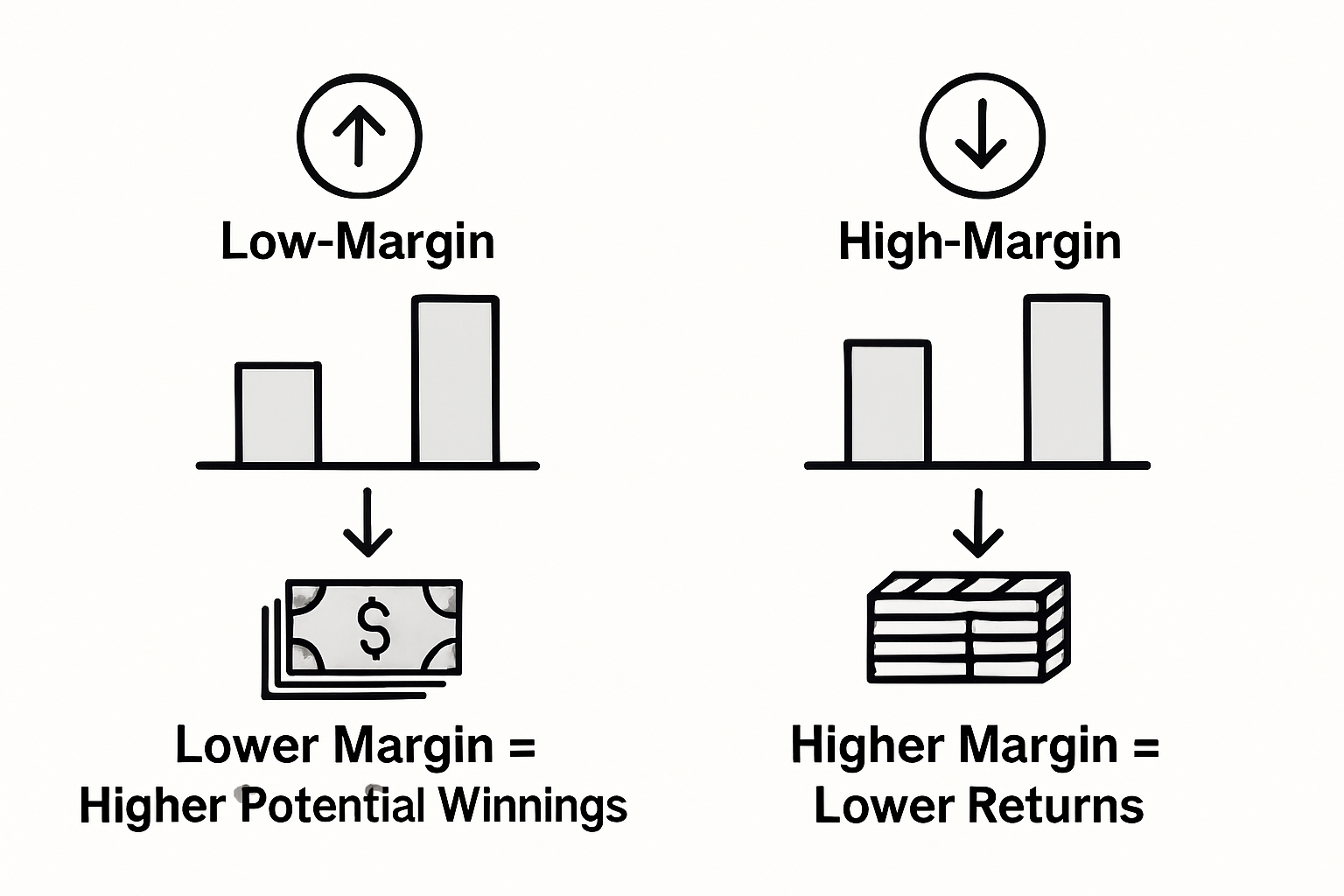
Understanding betting margins becomes most revealing through concrete scenarios that demonstrate their real-world mathematical impact. Betting margin calculations reveal how seemingly small percentage differences can dramatically influence potential winnings across various sporting events.
Consider a hypothetical soccer match with decimal odds of 1.91 for both potential outcomes. By applying the standard margin calculation method, we transform these odds into implied probabilities: (1 / 1.91) x 100 = 52.36% for each potential result. When these probabilities are combined (52.36% + 52.36%), they total 104.72%. Subtracting 100% reveals a 4.72% bookmaker margin, which represents the built-in mathematical advantage guaranteeing the sportsbook’s profitability.
Different sporting events demonstrate unique margin characteristics that substantially impact betting dynamics. Football matches typically feature tighter margins around 4% to 5%, while more specialized or niche sporting events might see margins expanding to 7% or 8%. Implied probability serves as the critical metric that allows bettors to understand the true mathematical landscape underlying each wager.
- Margins vary significantly across different sports
- Tighter margins indicate more competitive betting environments
- Professional bettors calculate margins to identify value opportunities
- Small margin differences can represent substantial financial impacts
Mastering margin understanding transforms betting from pure chance to a more strategic financial endeavor. By recognizing how these mathematical mechanisms operate, bettors can make more informed decisions and potentially improve their long-term wagering outcomes.
Minimizing Losses and Maximizing Value as a Bettor
Navigating the complex landscape of sports betting requires strategic approaches to overcome inherent bookmaker margins. Identifying value opportunities becomes critical in transforming betting from a pure chance activity to a more calculated financial endeavor.
Professional bettors employ multiple sophisticated techniques to minimize losses and maximize potential returns. Market comparison stands as a fundamental strategy, involving meticulous odds tracking across different sportsbooks to identify the most favorable lines. By comparing margins and implied probabilities, bettors can discover subtle pricing inefficiencies that provide marginal yet significant advantages.
Effective margin management involves understanding market dynamics and developing disciplined betting practices. Key strategies include betting early when lines are sharper, recognizing public betting biases that distort true pricing, and consistently tracking your Closing Line Value (CLV). These approaches help counteract the mathematical advantage built into betting margins, allowing more strategic wagering decisions.
- Compare odds across multiple sportsbooks
- Recognize and exploit market inefficiencies
- Develop disciplined betting strategies
- Track and analyze your betting performance consistently
- Focus on long-term value rather than short-term wins
Successful betting is less about predicting outcomes and more about understanding mathematical probabilities and market dynamics. By approaching sports wagering as a calculated investment strategy, bettors can systematically improve their chances of generating consistent returns.
Take Control of Your Betting Edge with Betco AG
Understanding the betting margin is key to mastering how sportsbooks set odds and how you can maximize your winnings. This article reveals how betting margins affect your potential returns and why recognizing concepts like implied probability and margin calculations can transform your betting strategy. If you have ever felt frustrated by hidden bookmaker advantages or wanted to find better ways to identify value bets Betco AG offers the perfect platform to put this knowledge into action.

Explore expert insights and proven strategies in our Sports Betting Tips, Strategies & Insights | Category Betco. Dive deeper into betting concepts on our Sports Betting Guides and Resources | Betco. Then visit https://betco.ag to experience a comprehensive betting environment with competitive odds and tools designed for both casual and professional bettors. Start managing your betting margins smartly today and gain the confidence to make more profitable wagers with Betco AG.
Frequently Asked Questions
What is a betting margin in sports betting?
A betting margin, also known as vigorish or juice, is a built-in commission that bookmakers take to ensure profitability. It subtly adjusts the odds in order to guarantee a consistent profit for the sportsbook regardless of the event outcome.
How do betting margins affect my potential winnings?
Betting margins directly impact the odds provided by sportsbooks, which in turn affects your potential winnings. A lower margin typically means more favorable odds for bettors, increasing the chances of generating positive returns.
How can I calculate the betting margin for a specific bet?
To calculate the betting margin, convert the betting odds into implied probabilities, combine the probabilities for both outcomes, and subtract 100%. This will give you the bookmaker’s margin as a percentage. For example, odds of 1.91 yield a 4.72% margin when you calculate the implied probabilities.
What strategies can I use to minimize losses while betting?
To minimize losses, consider comparing odds across different sportsbooks, recognizing market inefficiencies, betting early to capture sharper lines, and tracking your betting performance by focusing on Closing Line Value (CLV). These strategies help you make more informed and strategic betting decisions.